
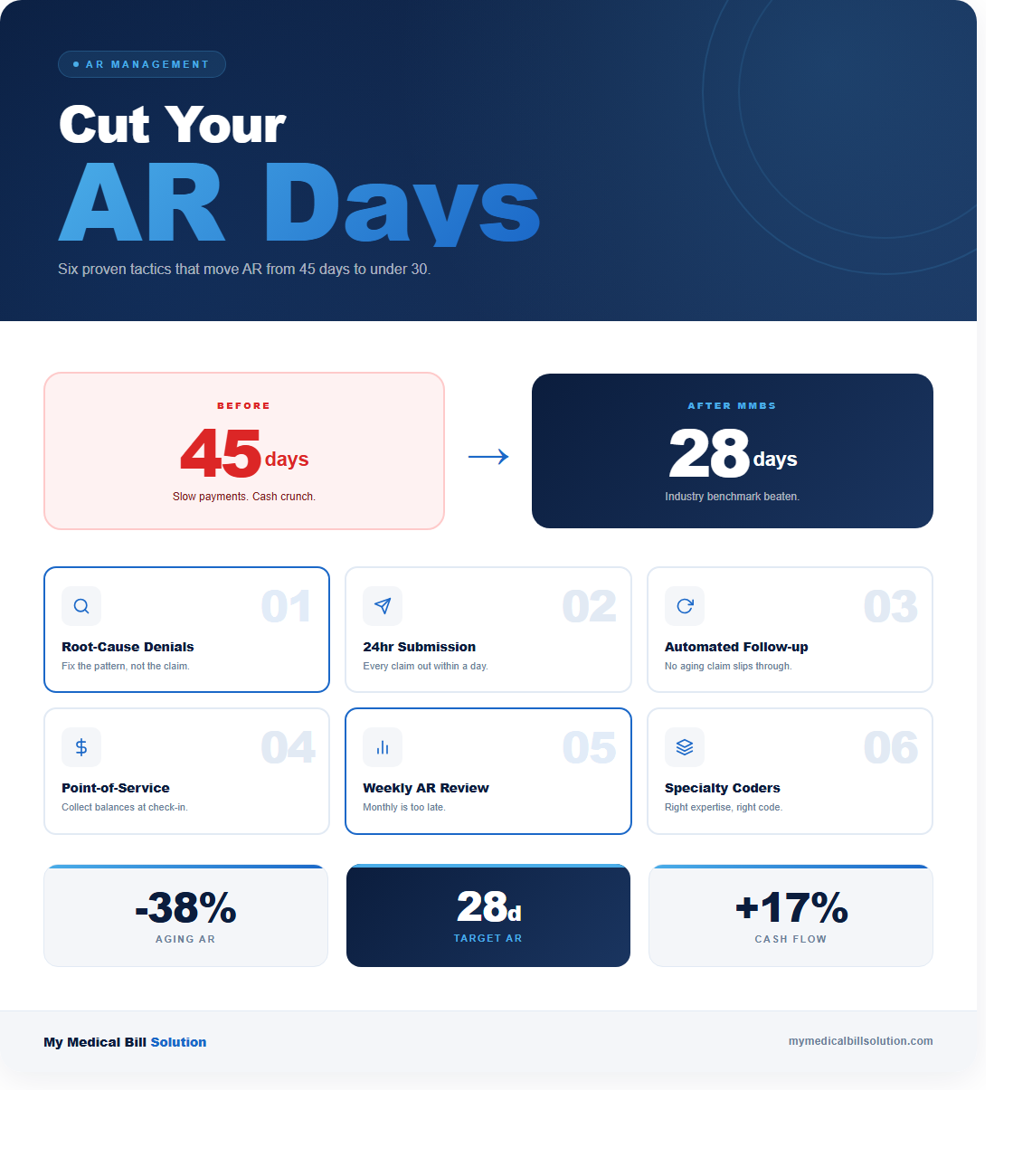
How to Reduce Days in Accounts Receivable for Physician Practices: Proven Revenue Cycle Strategies is a practical guide built around the workflows that MMBS (MyMedicalBillSolution.com) billing specialists use every day to move average AR days from the industry norm of 45 to 55 down to 28 to 32. Days in accounts receivable is one of the most telling indicators of billing health, yet many practices track it infrequently, benchmark it against the wrong standard, or fail to connect the metric to the specific workflow failures causing it to climb. This guide covers what AR days means, what good performance looks like by specialty, and five concrete tactics that move the number in the right direction. MMBS maintains an average AR days rate of 28 to 32 across all client practices, a result of structured claim submission, automated follow-up, and weekly aging reviews that identify problem claims before they reach the 60-day threshold.
TL;DR: To reduce days in AR: 1) Submit clean claims within 48 hours of a signed encounter note. 2) Run root-cause denial analysis on CO-16, CO-22, and CO-29 patterns before reworking individual claims. 3) Follow up on unpaid claims at day 30 for commercial payers and day 45 for Medicare. Practices using this workflow routinely reach 28 to 32 AR days, versus the 45 to 55 day industry average.
What Days in AR Means and How to Calculate It for Your Physician Practice
Days in AR measures how long it takes, on average, for a practice to collect payment after a service is rendered. The formula is straightforward: divide total accounts receivable by average daily charges. If your practice carries $500,000 in open AR and your average daily charges are $10,000, your days in AR is 50. Every day a claim sits uncollected is a day that revenue is not available for payroll, supplies, or growth. High AR days also increase the probability that claims will never be collected because payer filing deadlines expire and appeal windows close.
- Metric: Days in Accounts Receivable (AR days)
- Formula: Total AR balance divided by average daily charges
- Industry average: 45 to 55 days across all specialties (MGMA reference data)
- Primary care target: Below 30 AR days
- Specialty practice target: 35 to 45 AR days
- High-risk threshold: Above 55 AR days (indicates systematic workflow failure)
- MMBS benchmark: 28 to 32 AR days across all 50 states and 101 specialties
- Controlled by: Claim submission speed, denial rate, follow-up cadence, and remittance posting turnaround
CMS (Centers for Medicare & Medicaid Services) administers Medicare Part B and publishes the annual Physician Fee Schedule, which sets reimbursement rates for office visit CPT codes and drives the clean claim standards practices must meet. A clean claim processes straight through adjudication without a denial or a request for additional information. The gap in clean claim performance between in-house and outsourced billing is the primary driver of the AR days difference physicians see when they switch to a specialized revenue cycle management partner.
AR Days Benchmarks by Specialty: What Good Performance Looks Like for Physician Billing
MGMA (Medical Group Management Association) publishes reference data showing that primary care practices should target AR days below 30. Specialty practices typically run 35 to 45 days depending on payer mix and case complexity. Surgical specialties, which often involve longer adjudication timelines, sometimes run 45 to 55 days without indicating a serious process failure. Any practice consistently above 55 days should actively investigate root causes.
More useful than the overall number is a breakdown of AR by age bucket: current (0 to 30 days), 31 to 60 days, 61 to 90 days, and 90-plus days. The 90-plus bucket is where practices lose real money. Claims in that range carry a dramatically lower probability of collection and in many cases are approaching or past payer filing deadlines. MMBS billing specialists review aged AR buckets weekly, not monthly, to catch claims before they age past the point of recovery. For practices evaluating whether outsourcing can solve the AR problem, our end-to-end revenue cycle management service includes a full AR aging audit in the first 30 days of engagement.
Root-Cause Denial Analysis: Fixing Claim Denials Before They Enter the AR Queue
Most practices with high AR days have a denial problem they solve reactively. A claim gets denied. A biller places it in a work queue. Someone works it weeks later. Meanwhile, the claim ages, the payer appeal window narrows, and some claims slip past filing deadlines entirely. The better approach is to analyze denial patterns and correct the upstream cause.
CO-16 (CARC code 16, meaning claim lacks information or has submission or billing errors) is one of the most common denial reasons across all specialties. If 30% of your denials carry CO-16, the fix is not a faster rework workflow. It is identifying which CPT codes, which providers, or which payer-specific billing rules are generating the incomplete submissions, then correcting the EHR (Electronic Health Record) template or coding workflow at the source. Similarly, CO-29 (CARC code 29, meaning the time limit for filing has expired) appearing in aged AR signals a process failure, not a payer problem. Our CO-16 submission error resolution guide walks through the most common field corrections that prevent this denial from recurring.
Eligibility failures (often listed as CO-4 or CO-22) frequently trace back to NPI (National Provider Identifier) mismatches or incorrect subscriber ID on the 837P claim file, which must comply with HIPAA (Health Insurance Portability and Accountability Act, 45 CFR Parts 160 and 164) ASC X12 transaction standards. Pre-visit eligibility verification resolves these before a claim is submitted. Our claims-management workflow includes real-time eligibility verification on every scheduled appointment, eliminating this category of denial at the source.
Claim Submission Turnaround Standards: Reducing the Gap Between Service Date and Claim Filing
The gap between date of service and claim submission is one of the most controllable factors in AR days. Every day between when a service is rendered and when a clean claim is submitted adds directly to your AR total. Practices that submit clean claims within 24 to 48 hours of service consistently carry lower AR days than those operating on 5 to 7 day submission cycles.
Setting a written standard, claims must be submitted within 48 hours of the signed encounter note, and tracking how often that standard is met gives practices a clear leading indicator of AR performance. AAPC (American Academy of Professional Coders, the certifying body that issues CPC and COC credentials) guidance on documentation standards establishes that complete, timely documentation is the foundation of accurate CPT code assignment. Delayed provider signatures mean delayed coding, delayed submission, and directly inflated AR days.
Our specialty-specific medical coding service includes same-day coding turnaround on signed encounter notes, which is a key reason MMBS clients see faster claim submission cycles than internally billed practices.
Automated AR Follow-Up Workflows: How to Prevent Unpaid Claims from Aging Past Collection Deadlines
Unpaid claims get paid because a specific person, following a specific process, contacts the payer at a specific interval and documents the outcome. Practices that rely on billers to manually recall which claims need follow-up will always have AR leakage. The standard follow-up cadence for commercial payers is day 30 after submission, or the payer's standard adjudication window plus five business days. For Medicare Part B and Medicaid, the appropriate touchpoint is day 45.
At each follow-up touchpoint, the biller checks claim status through the payer portal or via ERA (Electronic Remittance Advice, the electronic equivalent of the EOB or Explanation of Benefits), documents the response, and escalates to a formal appeal if the claim has been denied. EOB review is also how practices catch secondary billing opportunities and contractual adjustment errors that quietly reduce net collections. This workflow should run through automated task queues in your practice management system, not through memory or manual spreadsheets. For practices billing government payers, our Medicare billing adjudication guide covers the specific timelines and follow-up rules that govern Part B claims.
Patient Balance Collection at the Point of Service: Reducing Patient AR Before It Starts
A significant portion of high AR days in many practices comes from patient balances, not insurance balances. When high-deductible health plans dominate a payer mix, patient responsibility amounts accumulate quickly. Run eligibility verification before each appointment, calculate the estimated patient cost based on current deductible status and copay amounts, and collect at check-in. Prior authorization (the payer approval process required before certain procedures are performed, governed by individual plan medical policies) should be confirmed at scheduling, not at the time of service, to avoid non-covered service balances aging in patient AR. Our practice billing management services include front-end eligibility verification and prior authorization coordination as standard workflow components.
Weekly AR Reporting Cadence: Why Monthly AR Reviews Cost Practices Revenue
Practices that review AR days once a month cannot act on problems fast enough. A payer that starts holding claims for an unexpected reason, a provider who fell behind on note signing, a biller focused on the wrong work queue: these problems appear in the data within days, but monthly reporting means they go undetected for three to four weeks. By then, claims that could have been corrected and resubmitted are approaching filing deadlines.
Pull AR aging reports weekly and review the 60-plus day bucket specifically. Track which payers are responsible for the oldest claims and whether they cluster around specific CPT codes. CPT 99213 (established patient office visit, level 3, average CMS reimbursement approximately $72 under the 2026 Physician Fee Schedule) accounts for a large share of primary care volume. When it shows up disproportionately in the 60-plus day bucket, it usually signals a documentation or modifier issue that can be corrected prospectively. Our CPT 99213 documentation and denial pattern guide covers the specific requirements for this high-volume code. Weekly visibility shortens the time between a problem starting and a solution being deployed.
How MMBS Handles AR Days: Certified Billing Team Performance Benchmarks
MMBS billing specialists are AAPC-certified (CPC and COC credentialed) and operate under CMS guidelines, Medicare Part B rules, and state Medicaid requirements for all 50 states. Every MMBS client account includes pre-visit eligibility verification, same-day claim submission on signed encounters, automated follow-up queues by payer, and weekly AR aging reviews that flag claims before they reach the 60-day threshold.
MMBS reduces average accounts receivable days to 28 to 32, compared to the industry average of 45 to 55 AR days. That 17 to 23 day gap translates directly into faster cash flow and a smaller percentage of claims aging into the uncollectable range. The denial management workflow that drives this result achieves an 85% first-pass resolution rate on appealable denials, which means fewer claims cycle back through the AR queue a second time. Our outsourced billing workflow overview covers the full process from claim submission through remittance posting.
Remittance posting (applying ERA and EOB payment data to open claims in the practice management system) is where many in-house billing teams fall behind. When posting is delayed, open AR balances remain inflated even after payers have issued payment. MMBS posts remittances within 24 hours of receipt under a signed Business Associate Agreement, in compliance with HIPAA (45 CFR Parts 160 and 164). Our HIPAA-compliant remittance and claims workflow keeps posting current so that secondary claims and denial follow-ups trigger on the correct timeline.
Frequently Asked Questions
What is a good days in AR benchmark for physician practices in 2026?
The benchmark for days in accounts receivable varies by specialty. Primary care practices should target AR days below 30. Specialty practices typically run 35 to 45 days. Surgical specialties may run 45 to 55 days without indicating a serious process problem. Any practice consistently above 55 AR days should investigate root causes in claim submission, denial management, and follow-up workflows. MMBS client practices average 28 to 32 AR days, roughly 17 to 23 days faster than the industry norm of 45 to 55.
What causes high accounts receivable days in medical billing?
High AR days most commonly trace to slow claim submission (more than 48 hours between service date and claim filing), elevated denial rates from coding or eligibility errors, an absence of structured payer follow-up, delayed remittance posting, and uncollected patient balances. CMS data shows that clean claim rates below 85% are a primary predictor of elevated AR. Practices with clean claim rates at or above 98% tend to resolve this problem at the front end rather than through reactive rework.
How does denial rate affect days in AR for medical practices?
Every denied claim that is not immediately re-worked and resubmitted adds directly to AR days. CARC code CO-16 (claim lacks information) and CO-22 (coordination of benefits) are among the most common denial reasons and often indicate upstream eligibility or NPI (National Provider Identifier) issues that can be corrected before the next claim batch. MMBS's denial management workflow achieves an 85% first-pass resolution rate on appealable denials, which directly reduces the volume of claims aging beyond 60 days in the AR queue.
What is the difference between an EOB and an ERA in medical billing?
An EOB (Explanation of Benefits) is the paper or PDF document a payer sends to explain how a claim was adjudicated, what was paid, what was adjusted, and what remains as patient responsibility. An ERA (Electronic Remittance Advice) is the electronic equivalent, delivered via the 835 transaction set under HIPAA (45 CFR Parts 160 and 164) EDI standards. ERAs allow billing systems to auto-post payments and flag denial codes automatically. Practices that process ERA data within 24 hours of receipt keep AR aging data current and trigger secondary billing and appeal follow-ups on the correct timeline.
How does prior authorization affect accounts receivable days?
Prior authorization failures are a leading cause of claim denials that age into high AR buckets. When a service is rendered without a required prior auth, the resulting denial often cannot be appealed retroactively and the balance becomes uncollectable. CMS requires prior authorization for certain procedures under Medicare Advantage plans, and commercial payers maintain their own pre-service approval requirements. Confirming prior authorization status at the scheduling step for every applicable CPT code eliminates this category of denial before a claim is ever submitted.
Can outsourcing medical billing reduce days in AR for a small practice?
Yes. Outsourcing to a certified billing company consistently reduces AR days because it replaces reactive, memory-based workflows with structured submission turnarounds, automated follow-up queues, and weekly AR aging reviews. AAPC-certified billers (CPC and COC credentialed) apply specialty-specific coding rules and payer-specific requirements that in-house generalists frequently miss. Practices evaluating outsourcing can review the full onboarding and workflow process on our outsourced billing services page to compare the operational difference.
If your practice's AR days are above your specialty benchmark and you are not certain why, MMBS offers a no-cost revenue cycle assessment that identifies the specific workflow failures driving the number up. Contact our team through our billing assessment request page to get a clear picture of where your AR stands and what a structured remediation plan looks like.