

90 Days Is All You Need to See Real Results
If your revenue cycle feels like it is working against you instead of for you, you are not imagining things. Delayed payments, rising denials, and growing accounts receivable are real problems that affect thousands of practices every day. But here is what most practice managers do not realize: you do not need a year-long overhaul to turn things around. With a focused 90-day plan, you can see measurable improvement in your cash flow, your denial rate, and your team morale.
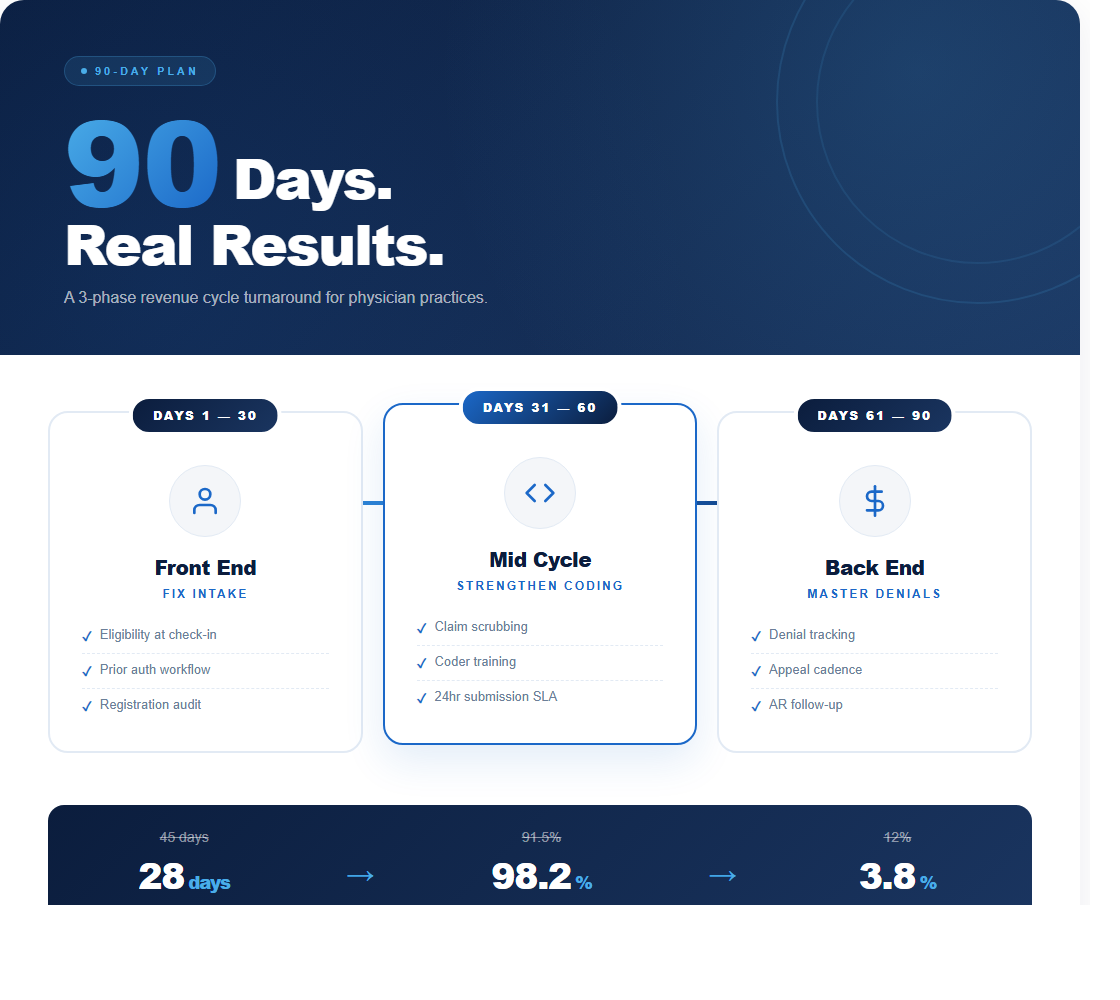
This plan breaks down into three 30-day phases. Each phase targets a different part of your revenue cycle, moving from the front end to the middle to the back end. By tackling one area at a time, you avoid overwhelming your team and you build momentum with each small win.
Days 1 to 30: Fix Your Front End
Your front end is where revenue is won or lost before a claim is ever submitted. According to the Advisory Board, up to 50% of claim denials originate from front-end issues. That means half of your denial problem can be solved by getting registration, verification, and authorization right.
Week 1: Audit your eligibility verification process. Pull a sample of 50 recent denials and check how many were caused by inactive coverage, wrong subscriber ID, or missing authorization. If more than 10% of your denials fall into these categories, your verification process needs immediate attention. Implement real-time electronic eligibility verification for every scheduled patient, run it the business day before the appointment, and flag any issues for your front desk team to resolve before the patient arrives.
Week 2: Standardize your registration workflow. Create a registration checklist that your front desk follows for every patient: verify name and date of birth against the insurance card, confirm subscriber ID and group number, collect a copy of the current insurance card (front and back), verify the referring provider NPI if required, and collect the copay. A simple checklist reduces data entry errors by 30% to 40%.
Week 3: Tackle prior authorizations. Prior auth failures are one of the most expensive denial categories because they often cannot be appealed after the service is already provided. Create a list of every service your practice performs that requires prior authorization, broken down by payer. Assign responsibility for obtaining authorizations to a specific team member, not “whoever has time.” Track authorization status in your PM system and do not allow a patient to be seen for an auth-required service until the authorization is confirmed.
Week 4: Measure your baseline. At the end of month one, calculate your current metrics: clean claim rate, first-pass denial rate, AR days, and net collection rate. These numbers become your baseline for measuring improvement over the next 60 days. If you do not know where you started, you cannot prove how far you have come.
Days 31 to 60: Strengthen Your Mid-Cycle
The mid-cycle is where clinical documentation becomes a financial claim. This is the domain of coding accuracy, charge capture, and claim scrubbing. Errors here are expensive because they result in denials that require clinical review, coder rework, and sometimes provider re-documentation.
Week 5: Conduct a coding accuracy audit. Pull 20 charts from each of your top three payers and have an independent coder review the code assignments. Compare the audit results to the codes that were actually billed. Are your coders consistently downcoding? Are specific denial-prone code combinations (like E/M with procedures) being handled correctly with modifier 25? A coding audit reveals patterns that daily production work never surfaces.
Week 6: Improve charge capture. Charge capture leakage, services performed but never billed, costs the average practice 1% to 5% of gross revenue. Review your encounter forms or superbills to make sure they include all billable services your providers commonly perform. If your practice has added new services, equipment, or procedures in the past 12 months, verify those codes are on the charge capture tool. Check that every encounter for the past two weeks resulted in a submitted claim.
Week 7: Optimize claim scrubbing. Your clearinghouse or billing software should catch errors before claims reach the payer. But these tools only work if they are configured correctly. Review your claim scrubbing rules: are NCCI edits enabled? Are payer-specific rules loaded? Is the system flagging missing modifiers, invalid diagnosis-procedure pairs, and frequency limits? Many practices have scrubbing tools that are turned on but not properly configured for their specialty.
Week 8: Reduce claim lag time. Measure the average number of days between the date of service and the date of claim submission. If it exceeds 5 days, identify the bottleneck. Is it provider documentation delays? Coding backlogs? Charge entry staffing? Set a target of submitting 95% of claims within 48 hours of the encounter. Every day you shave off your submission timeline is a day you shave off your AR.
Days 61 to 90: Master Your Back End
The back end is where you recover revenue that the front end and mid-cycle missed. Denial management, appeals, underpayment recovery, and patient collections all live here. This is often the most neglected part of the revenue cycle, and it is where the biggest quick wins hide.
Week 9: Build a denial management workflow. If your team is not working denials systematically, start now. Create a process: review all denials within 48 hours of receipt, categorize by reason code (CO-4, CO-16, CO-97, PR-1 are the most common), prioritize by dollar amount, and assign to specific team members. Track the outcome of every denial worked (overturned, upheld, or written off). Your goal by the end of this week is to have zero unworked denials older than 5 business days.
Week 10: Launch an underpayment review. Pull your top 20 CPT codes by volume and compare the reimbursement received from each major payer against your contracted rate. You are looking for claims where the payer paid less than the contracted amount. The average practice has 1% to 3% of net revenue in underpayments they never catch. When you find underpayments, submit a formal appeal with the contract rate and EOB attached. Most payers will correct verified underpayments within 30 days.
Week 11: Improve patient collections. Patient responsibility now accounts for 25% to 30% of practice revenue for many specialties. If you are not actively collecting from patients, this is a growing hole in your revenue cycle. Implement these three changes: collect copays and known deductible amounts at the time of service, send patient statements within 5 days of insurance adjudication (not monthly batches), and offer a patient payment portal with credit card and payment plan options. Practices that adopt all three see a 20% to 35% increase in patient collections within 60 days.
Week 12: Measure, compare, and plan forward. Calculate the same metrics you measured at the end of month one: clean claim rate, denial rate, AR days, and net collection rate. Compare them to your baseline. If you have followed this plan with even moderate consistency, you should see your denial rate drop by 2 to 4 percentage points, your AR days decrease by 5 to 15 days, and your net collection rate improve by 2% to 5%. For a practice with $2 million in annual collections, a 3% improvement in net collection rate means an additional $60,000 per year.
Keep the Momentum Going
The 90-day plan gets you moving. But revenue cycle improvement is not a one-time project. It is an ongoing discipline. After your initial 90 days, schedule a monthly revenue cycle review with your billing team. Spend 30 minutes reviewing your key metrics, discussing the top denial reasons from the past month, and identifying one area to improve in the next 30 days.
The practices that achieve the best long-term financial performance are not the ones with the fanciest software or the biggest billing teams. They are the ones that pay attention to their numbers consistently, act on what the data tells them, and treat their revenue cycle as the critical business function it truly is. You have the plan. Now it is time to put it to work for your practice.