

Prior authorization has become the most scrutinized utilization management tool in American healthcare. The AMA’s 2024 Prior Authorization Physician Survey found that 94% of physicians reported care delays associated with the process, while payers maintained that it prevented an estimated $10.2 billion in unnecessary medical spending the previous year. Whether you view it as a necessary guardrail or an administrative burden, prior authorization is deeply embedded in the revenue cycle, and understanding its mechanics is essential for any practice that wants to get paid consistently.
This guide covers the process from end to end: what prior authorization is, which services require it, how the major payers differ in their requirements, what the regulatory landscape looks like heading into 2026, and where automation is changing the equation.
Prior Authorization Defined
Prior authorization (also called precertification, pre-approval, or prior approval) is the process by which a health plan requires providers to obtain advance approval before delivering a specific service, procedure, or medication. The payer reviews clinical documentation to determine whether the proposed treatment meets their medical necessity criteria and coverage guidelines. Without that approval, the claim will be denied, even if the service was clinically appropriate.
The scope of services requiring prior auth has expanded significantly over the past decade. What once applied primarily to inpatient admissions and high-cost imaging now covers a broad range of outpatient procedures, diagnostic tests, specialty referrals, durable medical equipment, and pharmaceutical prescriptions. The AMA reports that physicians submit an average of 43 prior authorization requests per week, with each request consuming an estimated 13 minutes of staff time.
Which Services Typically Require Prior Authorization?
While requirements vary by payer and plan, the following categories consistently trigger prior authorization across most commercial insurers.
Advanced Imaging: MRI (CPT 70551-70559, 73721-73723), CT scans (74176-74178), PET scans (78811-78816), and nuclear medicine studies. Radiology benefit managers like EviCore Health and Carelon (formerly AIM Specialty Health) handle prior auth for imaging on behalf of many commercial payers, adding a layer of complexity to the approval process.
Surgical Procedures: Most elective and scheduled surgeries require prior auth, including joint replacements (CPT 27447 for total knee arthroplasty), spinal fusions (22551, 22612), and bariatric procedures (43644, 43775). Emergency surgeries are typically exempt, though retrospective review may apply.
Specialty Medications: Biologic agents, chemotherapy drugs, and specialty pharmaceuticals almost universally require prior authorization. Infusion-administered drugs billed under HCPCS J-codes (such as J9271 for pembrolizumab or J0135 for adalimumab) face particularly rigorous review due to their cost, which can exceed $10,000 per administration.
Mental Health and Behavioral Health Services: Ongoing therapy sessions beyond an initial evaluation, intensive outpatient programs, and partial hospitalization programs typically require concurrent authorization. Some payers require re-authorization every 6 to 12 sessions, creating a continuous administrative burden for behavioral health practices.
Durable Medical Equipment (DME): Power wheelchairs, continuous glucose monitors, CPAP devices, and custom orthotics all require prior authorization, accompanied by detailed documentation of medical necessity including physician orders, clinical notes, and sometimes a certificate of medical necessity form.
Payer-Specific Differences: UHC vs. Aetna vs. BCBS vs. Cigna
One of the most challenging aspects of prior authorization is that every payer operates under different rules, different portals, different turnaround commitments, and different clinical criteria. Understanding these differences is not optional for billing teams. It is operational survival.
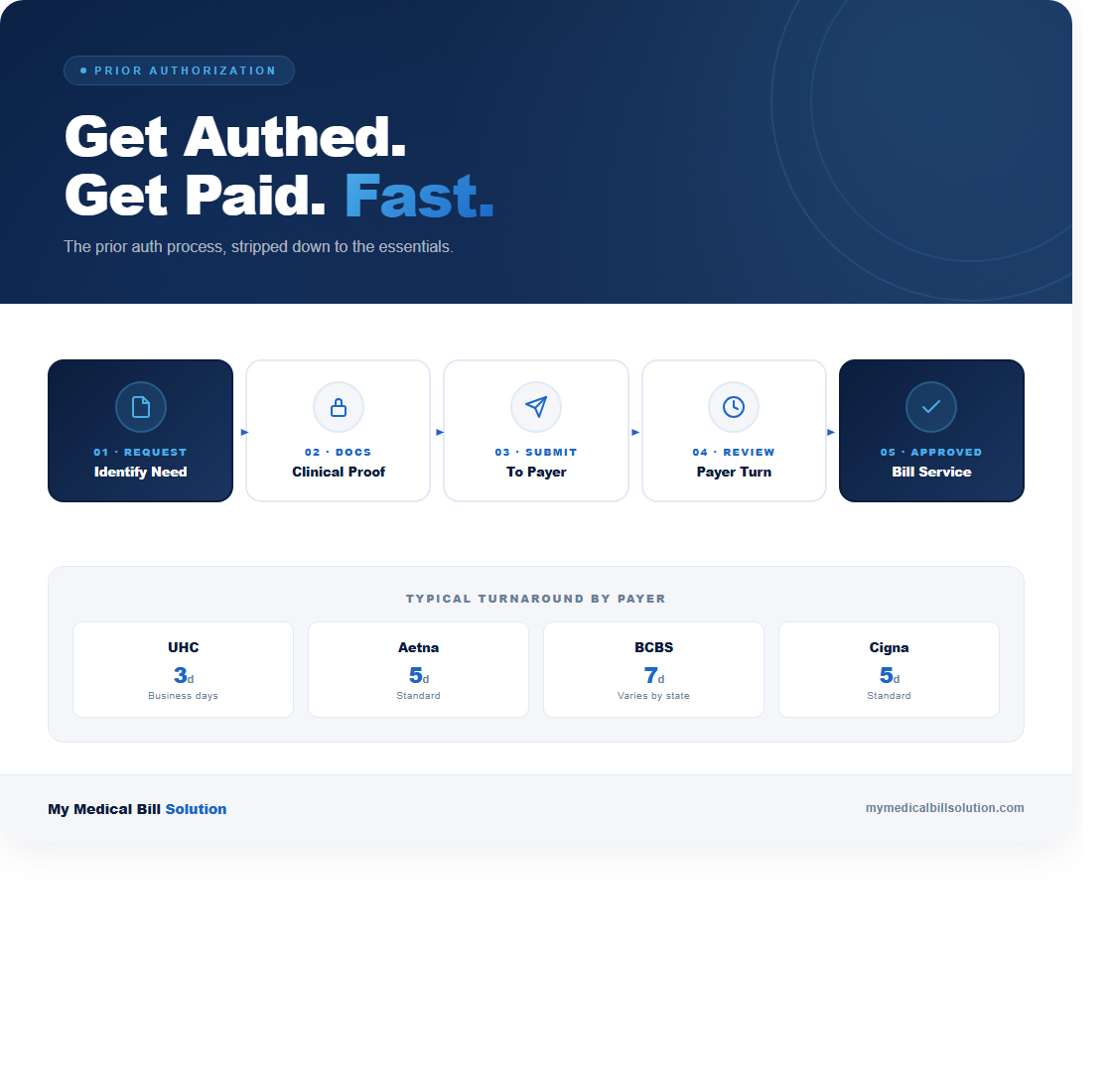
UnitedHealthcare: Uses the UHC Provider Portal for electronic prior auth submissions. Standard turnaround is 5 business days for non-urgent requests, 24 hours for urgent cases. UHC has been expanding its “Gold Card” program, which exempts providers with consistently high approval rates (90%+) from prior auth requirements for specific procedure categories. However, eligibility for the Gold Card program is evaluated quarterly and can be revoked.
Aetna: Submits through the Availity portal or Aetna’s provider website. Aetna generally follows a 5 to 7 business day standard turnaround and 72 hours for urgent requests. Aetna has adopted InterQual clinical criteria (owned by Change Healthcare) for most medical necessity determinations, which means the clinical documentation must align with InterQual’s evidence-based guidelines rather than proprietary Aetna criteria.
Blue Cross Blue Shield: The complexity here is that BCBS operates as 34 independent licensees, each with its own prior auth requirements, portals, and criteria. BCBS of Massachusetts has different rules than BCBS of Texas, which differs from Anthem BCBS. Practices operating across state lines or seeing patients with out-of-state BCBS plans must navigate multiple systems. Many BCBS plans use the iExchange portal, but not all.
Cigna: Uses the Cigna for Health Care Professionals portal. Cigna has been notable for its adoption of eviCore for specialty benefit management, routing prior auth requests for imaging, cardiology procedures, musculoskeletal services, and lab/pathology through eviCore’s platform rather than Cigna’s own system. Standard turnaround is 5 business days, with 24-hour expedited review available for urgent clinical situations.
Regulatory Changes: CMS and State-Level Reform
The regulatory environment around prior authorization is shifting meaningfully. CMS finalized the Interoperability and Prior Authorization Final Rule (CMS-0057-F) in January 2024, with implementation timelines extending into 2026 and 2027. The key provisions include requirements for Medicare Advantage, Medicaid, and CHIP plans to implement a Prior Authorization API (using HL7 FHIR standards) that will allow providers to submit and track prior auth requests electronically through their EHR systems.
The rule also requires payers to provide a specific reason for denial (not just a generic “does not meet criteria” response) and mandates turnaround times of 72 hours for standard requests and 24 hours for urgent requests. Plans must also publicly report their prior authorization approval rates, denial rates, and average decision times, which introduces a transparency mechanism that has never existed at this scale.
At the state level, more than 30 states have enacted or proposed prior authorization reform legislation. Texas (SB 2476), enacted in 2023, requires health plans to respond to prior auth requests within 2 business days and to honor approved prior authorizations for the duration of the prescribed treatment. California, New York, and Florida have enacted similar measures. The trend is clear: regulators are compressing timelines and adding accountability requirements for payers.
The Revenue Cycle Impact
Prior authorization delays directly inflate accounts receivable days and reduce first-pass claim resolution rates. A study published by the CAQH Index estimated that the healthcare industry spends $4.7 billion annually on prior authorization transactions. The average manual prior auth transaction costs $11.42, compared to $1.89 for a fully electronic transaction.
For practices, the financial impact extends beyond the direct administrative cost. Delayed prior authorizations delay procedures, which delays billing, which delays revenue. A cardiac catheterization lab that waits 8 days for prior auth approval loses not just 8 days of billing time but potentially the patient entirely, as patients sometimes seek care at facilities that can schedule faster.
Denied prior authorizations that proceed to peer-to-peer review add physician time to the administrative burden. The AMA estimates that physicians spend 14 hours per week on prior authorization activities, time that could otherwise generate an estimated $4,500 to $6,000 in clinical revenue.
Automation and the Path Forward
Electronic prior authorization (ePA) adoption is accelerating but remains incomplete. The CAQH 2024 Index reported that only 31% of prior authorization transactions are fully electronic, compared to 85% for claims submission and 78% for eligibility verification. The gap represents both a problem and an opportunity.
Several technology solutions are gaining traction. EHR-integrated prior auth modules (available in Epic, athenahealth, and eClinicalWorks) allow clinicians to initiate requests directly from the patient chart. Third-party platforms like Cohere Health, Rhyme (formerly Olive AI), and Infinitus use AI to automate submission, status tracking, and documentation assembly. Early adopters report 40 to 60% reductions in staff time per authorization and 15 to 25% improvements in approval turnaround.
The CMS FHIR API mandate, once fully implemented, should create a standardized electronic submission pathway that replaces the current fragmented landscape of payer-specific portals, fax submissions, and phone calls. That transition will take time, but the direction is established.
For practices operating today, the immediate priorities are clear: build a dedicated prior auth workflow, track approval rates by payer and service type, invest in electronic submission tools where ROI justifies it, and ensure that clinical documentation supports medical necessity before the request is submitted. Prior authorization is not going away, but how efficiently you manage it determines whether it is a manageable administrative task or a persistent drain on your revenue cycle.