How to Successfully Appeal a CO-16 Denial: Complete Step-by-Step Guide
CO-16 is one of the most frequently encountered denial codes in medical billing. It appears in approximately 8 to 12 percent of all claim denials across healthcare settings, making it a critical pain point for billing departments. Understanding what CO-16 means, why it occurs, and how to appeal it successfully is essential for managing cash flow and minimizing lost revenue. This guide covers everything you need to know to resolve CO-16 denials quickly and prevent recurrence.
What Does CO-16 Mean?
CO-16 is a Claim Adjustment Reason Code (CARC) that translates to claim lacks information needed for adjudication. In plain language, the insurance company is stating that they do not have enough information to process your claim properly. This does not mean the claim is invalid or fraudulent. It simply means the payer needs additional documentation, medical records, or clinical information before they can make a payment decision.
CO-16 differs from outright rejection codes. The claim is still potentially recoverable through the appeal process, provided you supply the missing information. However, many providers and billers give up on CO-16 denials without appealing, assuming they are permanent. This is incorrect and costly.
Common RARC Pairings with CO-16
CO-16 frequently appears with Remittance Advice Remark Codes (RARCs) that specify what information is missing. Understanding these pairings helps you address the correct issue on appeal.
CO-16 with N4 (This is not an allowed service because of program restrictions): The payer is indicating not just missing information, but that the service may not be covered under the specific patient’s plan. This often occurs with specialist referrals where prior authorization was required but not obtained. To appeal, obtain the patient’s eligibility verification and any prior authorization documentation.
CO-16 with MA130 (Your claim contains insufficient/incomplete information and we are unable to process it as submitted): This is the most common pairing and indicates missing clinical documentation, invalid diagnosis codes, or insufficient procedure description. Appeals for MA130 typically require submitting complete medical records or clarifying documentation.
CO-16 with N56 (This provider is not authorized to bill Medicare for this service): This indicates a provider credential or network issue, not missing information per se. However, it frequently appears alongside CO-16. Resolution requires verifying provider enrollment status and correcting billing provider identifiers on resubmission.
Other common RARCs paired with CO-16: N47 (This is not an allowed service for the indicated patient’s age), N64 (Missing or invalid provider identifier), N65 (Missing or invalid patient identifier). Each pairing points to different missing elements and requires specific documentation to resolve.
Five Most Common Causes of CO-16 Denials
Cause 1: Missing Medical Necessity Documentation The payer received the claim but lacks the clinical documentation proving the service was medically necessary. This occurs when office notes are too brief, lack specific diagnosis codes, or fail to document the patient’s symptoms or conditions justifying the procedure or service.
Example: A claim for bilateral shoulder imaging (CPT 73600) is denied CO-16. Upon investigation, the office note states only shoulder pain without describing laterality, duration, prior imaging, or symptoms. The payer cannot adjudicate without knowing if imaging was truly necessary for both shoulders or just one. Resubmission with a detailed note explaining the bilateral presentation resolves this.
Cause 2: Missing or Invalid Diagnosis Codes The claim was submitted with insufficient or outdated diagnosis codes. This can occur when the coder selected a non-specific code (like M79.3 for myalgia without specifying the site) instead of a more specific code required by the payer’s medical review guidelines.
Example: A physical therapy claim is denied CO-16. The diagnosis code used was G89.2 (Chronic pain, unspecified). However, the payer’s policy requires the specific anatomical site (e.g., M25.5 for pain in joint, knee). Resubmission with the specific code clears the denial.
Cause 3: Missing Prior Authorization or Referral The service requires authorization from the patient’s primary care provider or insurance company, and the authorization documentation was not included with the claim. This is common for specialty referrals, advanced imaging, and certain surgical procedures.
Example: A cardiology consultation claim is denied CO-16 with RARC MA130. Upon review, the authorization request was submitted 30 days prior, but the authorization number was never entered on the claim. Resubmission with the authorization number and supporting authorization approval letter resolves the issue.
Cause 4: Incomplete Patient or Provider Information The claim was missing or contained incorrect patient identifiers (member ID, date of birth), provider identifiers (NPI, tax ID), or facility information. Payers cannot match claims to patient records without this basic information.
Example: A claim is denied CO-16 with RARC N65 (Missing or invalid patient identifier). The member ID was transposed (08765432 instead of 08756432). Correcting the identifier and resubmitting clears the denial automatically.
Cause 5: Missing Modifier or Incomplete Code Description The service requires a specific modifier to describe what was done, or the CPT code description is insufficient without additional context. Common examples include services requiring the 25 modifier (significant, separately identifiable E/M service) or procedures requiring side/site/laterality specificity.
Example: A skin lesion removal (CPT 11400) is denied CO-16 without clear documentation of how many lesions were removed or the site. While one lesion removal is straightforward, multiple lesions or specific high-risk locations require detailed documentation. Resubmission with a pathology report or operative note detailing the lesion(s) resolves this.
Step-by-Step CO-16 Appeal Process
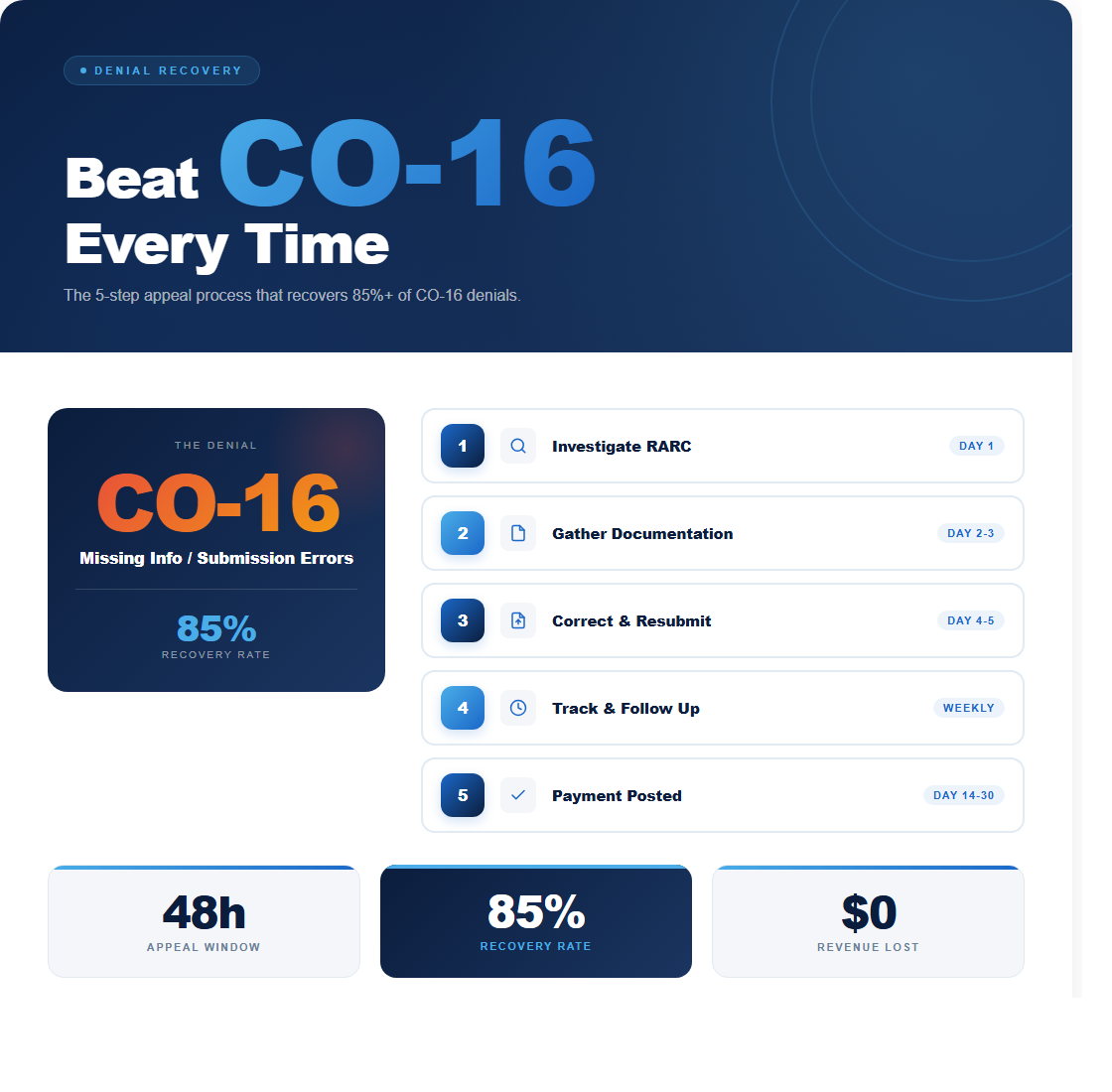
Step 1: Review the Original Denial Explanation Obtain the Explanation of Benefits (EOB) or remittance advice and locate the specific denial reason. Note the CARC (CO-16) and any paired RARCs. Identify the exact claim line that was denied. If multiple lines were denied, determine if all have the same reason or different reasons.
Step 2: Gather Supporting Medical Records Based on the specific RARC, gather the documentation that was missing. This typically includes: office notes from the date of service, test results or imaging reports, prior authorization documentation, medical necessity statements, pathology reports, operative summaries, or patient records from referring providers.
Step 3: Prepare an Appeal Letter Write a clear, concise appeal letter that includes the claim details (service date, claim number, patient name and member ID), the original denial reason (CARC/RARC codes), and a statement of what information is being provided on appeal and why it supports approval. Do not argue or become emotional. Stick to facts and clinical documentation.
Example appeal letter opening: We received a CO-16 denial with RARC MA130 for claim number 12345678, dated January 15, 2026, for patient John Smith (Member ID 08765432). The payer indicated insufficient information for adjudication. We are resubmitting this claim with complete medical records from the date of service, which document the medical necessity for the requested service.
Step 4: Organize and Submit Appeal Package Create a clean, organized submission package that includes the appeal letter, corrected claim form, and supporting medical records. Most payers prefer appeal submissions through their online portals when available. For paper submissions, mail to the appeal address shown on the remittance advice, not to claims submission addresses (these are different for most payers).
Step 5: Track Appeal Status Document the appeal submission date and method. Follow up after 14-21 days if you have not received a response. Most payers have appeal resolution timeframes of 30 days for standard appeals and 60 days for extended reviews. Track the appeal in your denial management system.
Step 6: Respond to Appeal Questions Some payers will request additional information during the appeal process. Respond promptly to keep the appeal moving. Delays in responding can result in appeal denial by default.
Medical Documentation Requirements for Successful Appeals
The strongest CO-16 appeals include complete office visit documentation with specific findings, diagnosis codes that are specific and appropriate to the clinical presentation, complete operative reports or procedure notes for surgical services, pathology or lab reports when applicable, and any prior authorization documentation or medical necessity statements.
Best practice documentation includes: chief complaint or reason for visit, history of present illness with specific symptoms and duration, relevant past medical and surgical history, review of systems, physical examination findings relevant to the diagnosis and procedure, assessment with specific diagnosis codes, plan with explanation of why the procedure or service was necessary, and provider signature with credentials noted.
Example of strong documentation that supports CO-16 appeal: Patient presents with right shoulder pain lasting 6 weeks. Pain is constant, rates 7 out of 10, worse with overhead activity. Prior X-ray (date) showed no acute fracture. Exam reveals limited range of motion, positive Neer test, positive Hawkins test. Assessment: suspected rotator cuff tear, right shoulder. Recommendation: MRI shoulder to confirm diagnosis and guide treatment. Patient consents. Plan: MRI scheduled. Diagnosis code: M75.12 (Complete rotator cuff tear, right shoulder).
Prevention Strategies: Avoid CO-16 Denials
The best approach to CO-16 is prevention. Implement these strategies to reduce initial denials.
Require Complete Office Notes Before Billing: Establish a workflow where billing staff do not submit a claim until the office note is complete and reviewed for medical necessity documentation. Many denials occur because incomplete notes were submitted.
Use Documentation Templates: Standardize office note templates that ensure all required elements are documented (history, findings, assessment, plan). This reduces the risk of missing key information.
Verify Diagnosis Codes Match Clinical Documentation: Ensure that diagnosis codes used are specific and supported by the documentation. Do not use catch-all codes like pain, unspecified when the documentation clearly indicates a specific anatomical site.
Confirm Prior Authorization Before Submitting: For services that require authorization, verify the authorization is active and that the authorization number is correctly entered on the claim. Many CO-16 denials result from missing authorization numbers.
Conduct Regular Denial Audits: Review CO-16 denials monthly to identify patterns. If a particular payer consistently denies specific services as CO-16, investigate whether their documentation or coding requirements differ from your assumptions. Adjust processes accordingly.
Tracking and Metrics for CO-16 Management
Implement tracking metrics to monitor CO-16 denial performance. Track: total number of CO-16 denials per month, trend in CO-16 denial rate (as percentage of all claims submitted), primary reasons for CO-16 denials, appeal success rate (percentage of CO-16 appeals resulting in payment), and average time from denial to appeal resolution.
A well-performing billing department should see CO-16 denial rates below 3 percent of all claims submitted. If your rate exceeds 5 percent, conduct a root cause analysis to identify whether the issue is incomplete documentation, missing prior authorization, or incorrect coding.
Conclusion: CO-16 Denials Are Recoverable
CO-16 denials are frustrating but recoverable with the right approach. The key is understanding what specific information the payer needs, gathering it promptly, and submitting a clear appeal with complete supporting documentation. Most CO-16 appeals are successful when resubmitted with the missing information. By implementing prevention strategies and maintaining organized appeal processes, practices can minimize CO-16 denials and recover lost revenue quickly.